
Ecology
Here you may learn about various flora and fauna that can be found in the world of Alaruk.Kariag
Kariags are large herbivorous herd animals that have adapted to grasslands and dry shrublands, and migrate depending on the climate's seasons. They are considered one of Alaruk's more docile and easily domesticated creatures, giving birth to precocious live young. Larger species can be ridden as mounts for transportation, while smaller species are bred for meat, leather, and even wool. Their diet consists of shrubs, grasses, forbs, and occasionally fruits. Standing on two legs, they are swift runners and use the horn on their snout for sparring and defense.
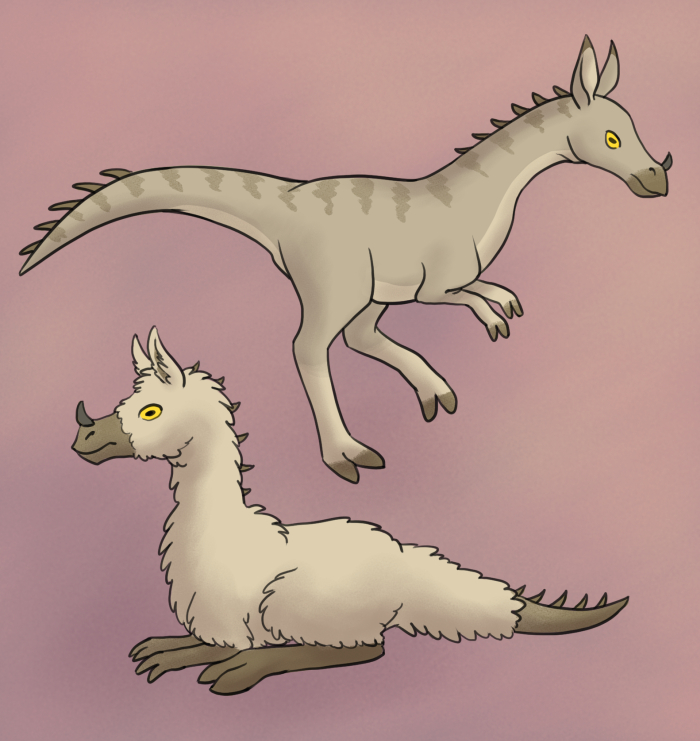
A typical kariag (top) and wooly kariag (bottom).
Kikri
The kikri is a semi-aquatic insect that preys on smaller insects and other tiny crustaceans. While it can spend several days out of the water, it still requires a source of water to fully submerge itself and hydrate. Seawater or slightly salty water is preferred by the kikri.
Fuglans may enjoy them as an occasional snack, but kikris are also useful for locating small bodies of water in the desert. They are surprisingly intelligent for their diminutive size, able to detect individual faces and even sense emotions.
Its physiology resembles something between a dragonfly and a shrimp, with large compound eyes, two sets of wings, and a powerful, finned tail.
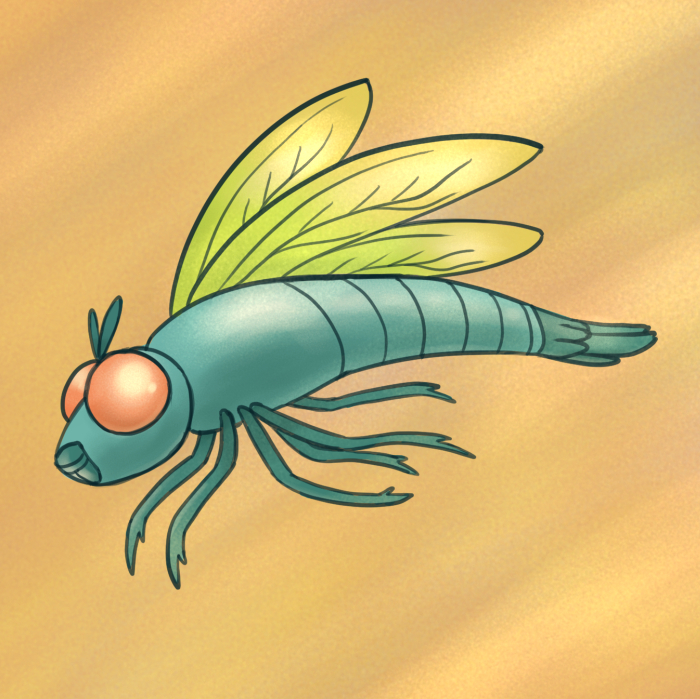
A kikri in flight.
Kudak
Kudaks are small gregarious creatures, roughly about the size of a rabbit. Warm blooded and covered in colorful feathers, they possess a set of wings and a keel bone necessary for flight. Large eyes help them see in low light, large ears for excellent hearing, and long thick tails for balancing in the treetops. Kudaks are oviparous and usually lay a clutch of two eggs once a year, right before the monsoon season begins. The eggs take about 24-26 days to hatch and nests may be located in large trees hollows or on cliffsides.
As frugivores, their favorite food is the tropical fruit of the nangangu tree, whose seeds they disperse widely in forested areas. They also feed on nuts and fruits of many other trees and will migrate during the change between seasons.
A kudak's long range call, used to establish territory and keep family groups together can be identified as "Koo-AHH!" Kudaks are highly social and capable of basic language but are less intelligent than fuglans and lack complex tools and technological capabilities. Some fuglans may keep them as companions, using them for long distance communication through oral messages.
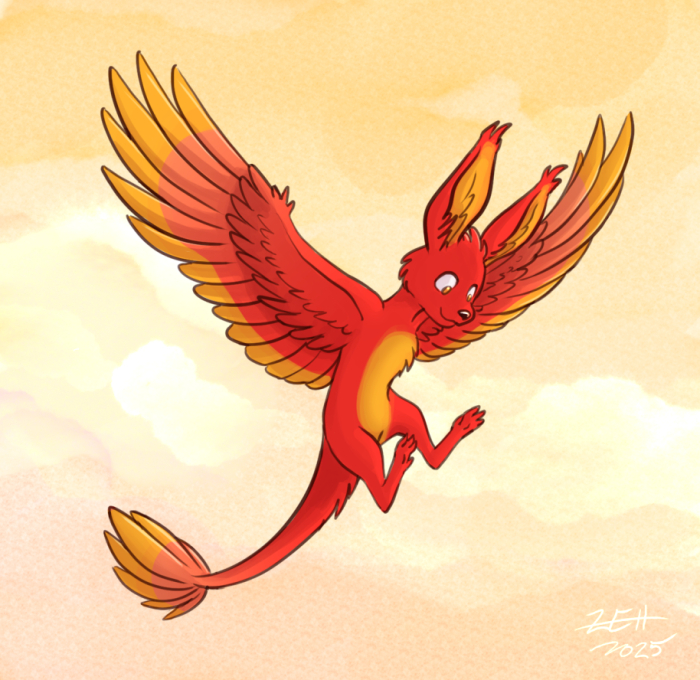
A red and yellow kudak in flight.
Rak
Raks are predatory obligate carnivores that are recognized as two main species, the Greater and Lesser rak. Similar in appearance but each different in body structure, raks sport tan fur, a striped back, and a large black and white striped tail. A forked tongue allows them to easily track down prey, making them excellent hunters. Both are warm-blooded and give birth to a litter of live young. While they can be tamed by fuglans, they are difficult to domesticate outside of their natural habitats.
Greater raks form large social structures and hunt in packs. Relentless hunters, they will chase large prey, such as kariags, for hours until they are driven to exhaustion. With powerful jaws, greater raks are capable of crushing bones. They are mostly found in grasslands, deserts, shrublands, and forests.
Lesser raks are smaller than their greater cousins, and are highly opportunistic predators. Their slim frame allows them to climb trees, hide in vegetation, and slip down tunnels. More solitary in nature, Lesser raks tend to hunt alone but may also nest with other raks. They are a widespread species, found in forests, deserts, swamps, and grasslands. Kudaks, including their eggs, is one of their favorite types of prey.
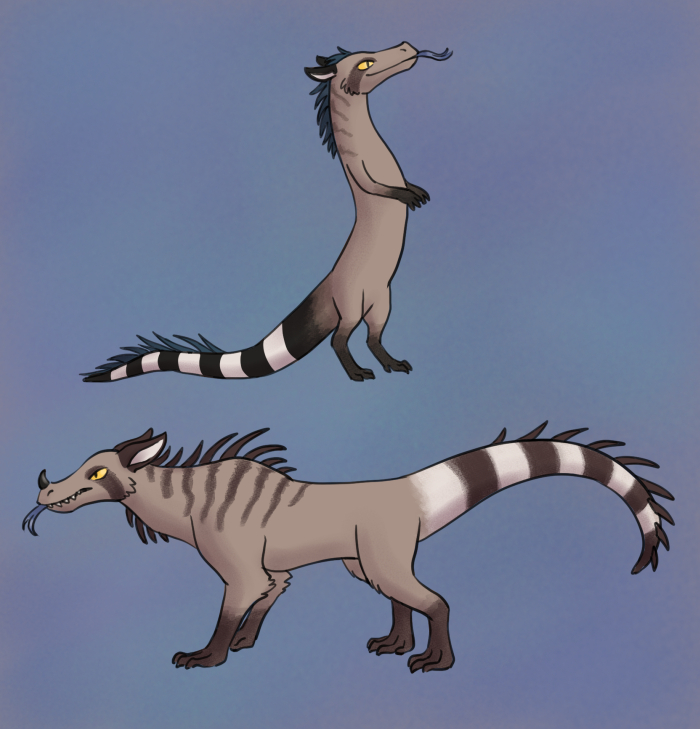
A lesser rak (top) and greater rak (bottom).
Back to Home
© Asuune 2023-2026